
 June 26, 2024
 10 min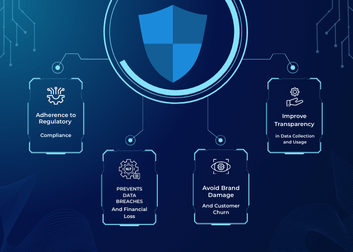
In an increasingly digital world, customers trust a business for being able to protect their personal data. In light of the ever-growing number of online data breaches and cyber threats, it is essential to be vigilant in following best practices for protecting customer data. Companies that protect data usually have increased credibility and trust, which signals long-term customer loyalty.
Additionally, protecting customer information is not only about the financial component but also about protecting the customer’s faith in the organization, as well as being competitive in the market. An organization can lose years of trust overnight due to one lapse in security, and keeping a record is meant to show the company has the credibility and takes the responsibility seriously in terms of data protection.
What is Customer Data Protection Strategy?
A customer data protection strategy is a systematized approach that organizations implement to protect their customers’ sensitive information that companies collect, process, and store. Protecting data guarantees that personal information like names, contact details, browsing habits, payment information, etc., is protected from unauthorized access, misuse, and data breaches. These high-level data protection tactics help organizations comply with data privacy, such as CCPA, GDPR or HIPAA, and build customer trust and loyalty using a commitment to protecting their information.
Additionally, a comprehensive customer data protection strategy encompasses technology, employee practices, and policies that establish multiple layers of defence. It further addresses potential risks by implementing preventive measures, response plans and detection systems. With the continued rise of cyberattacks and intentional data misuse, companies must continually update and review their strategies to minimise vulnerabilities and maintain customer confidence.
Why is it Essential to Implement Practices for Protecting Customer Data?
Recognizing how to implement practices for protecting customer data is vital to gaining trust, safeguarding sensitive data, and complying with data protection laws, which continue to arise.
1. Adherence to Regulatory Compliance
Safeguarding customer data is required by relatively new regulatory regimes, such as HIPAA, CCPA, and GDPR. If these laws are not met, fines and penalties may become a significant concern, disrupting business operations and potentially leading to lawsuits. An example is that GDPR fines can reach as high as 4% of a company’s global turnover, and violations of regulations can result in reputational damage and potential lawsuits.
2. Prevents Data Breaches and Financial Loss
Having good data protection in place helps to minimize the chances of costly data breaches, identity theft and unauthorized access. Data breaches cause not only an immediate financial loss, but often significantly more hidden costs (ongoing remediation, loss of business, and investigations). Along with performing investigations, regulatory investigations and negative publicity impact both immediate and long-term growth.
3. Avoid Brand Damage and Customer Churn
A single data breach can also bring negative publicity to an organization and a potential loss of customer loyalty. Numerous surveys have shown that more than half of consumers will avoid doing business with organizations that they know have suffered a privacy failure, contributing to increased churn and deterioration of brand value.
8 Best Practices For Protecting Customer Data to Implement in 2025
Organizations must adopt more than just basic security measures; they need to improve their policies and procedures and provide the required workforce training with best practices for protecting customer data to ensure trust, compliance and confidentiality. Better practices for protecting customer data, enforced with strict practices will protect sensitive data, engender customer loyalty, and build brand reputation, especially in a competitive digital landscape.
1. Employ Zero Trust Architecture
Implement a zero-trust architecture in any organization with assurance that no one (system or employee) is trusted on their own without validation by others. It follows the ” never trust, always verify” principle and makes sure only authorized persons have access to personal data. Here are a few aspects that businesses must keep in consideration.
- Verify who is accessing what and if the data and device are safe.
- Prepare for data breaches by implementing rigorous evaluations, tests and developing a risk mitigation plan.
- Offer systems or employees the minimum access they require.
- Ensure that devices connecting to the system are adequately secured.
- Use multi-factor authentication to prevent unauthorized access. Whenever suspicious or out-of-the-ordinary activities are observed, access may be restricted or denied outright.
- Employ micro-segmentation by dividing your system into smaller parts so that when a break-in occurs in one area, it can be contained, preventing it from spreading rapidly.
2. End-to-End Data Encryption
Data encryption is the process of transforming data into a coded format that can only be accessed or decrypted by individuals who possess the correct encryption key. So if an unauthorized person intercepts or steals data, they can prevent data from being read. This method prevents data from being readable if it is compromised or stolen by unauthorized individuals.
Ways to Incorporate:
When setting up an encryption process, an organization should:
- Use the Advanced Encryption Standard (AES) with a 256-bit key, which is considered the gold standard.
- Ensure that data is encrypted at rest (when stored) and in transit (when travelling over the network).
- Use encryption key management processes that protect encryption keys and rotate them regularly.
How does it secure confidential data?
Encryption is a process by which the data field in a message or data file is transformed into ciphertext, meaning that the message or file cannot be interpreted or detected without knowledge of the key. Besides encryption, there are other complementary data security measures (e.g., strong access controls).
3. Improve Transparency in Data Collection and Usage
Consumers generally begin to trust when they can control if and how their data is collected and for what purpose it is being used. All privacy laws require businesses to inform customers of their data handling practices through a document known as a privacy policy.
Your privacy policy must include a few factors, including:
- Categories of personal data collected
- Data retention duration
- Purpose of data collection
- Consumer or data subject rights
- Information on data sharing with third parties
- Contact information of the company
- Techniques to exercise specific rights
Instead of hiding your privacy policy in jargon, publish it in an understandable style. As an example, “We collect your email address to send you updates about your order status.”
4. Deploy Control Access Mechanism (CAM)
Access control mechanisms refer to technologies and policies leveraged to restrict access to sensitive data. They make sure that only authorized users can view or edit specific data, based on their role within the organization.
A Microsoft study revealed that 99.9% of compromised accounts did not use multi-factor authentication (MFA). This highlights the significance of access control in securing confidential data.
Ways to achieve CAM:
- Leverage multi-factor authentication, and require users to verify their identity with varied methods like password and mobile authentication applications.
- Implement regular audits to ensure that access permissions are up-to-date and tailored to each user’s role.
- Incorporate Role-based Access Control, limiting access based on a person’s role within the company.
How does it secure confidential data?
Access control mechanisms lessen the exposure of data by enabling only authorized persons to access sensitive information. The combination of MFA and RBAC not only helps protect data confidentiality but also provides layers of verification.
5. Implement Regular Data Security Audits
A data security audit process is a systematic assessment of a company’s information system to identify potential vulnerabilities. In contrast, continuous tracking relates to tracking in real-time (monitoring live network activity) with the goal of identifying, detecting and stopping unauthorized use.
Ways to conduct audits:
- Implement annual or bi-annual security data audit to detect system vulnerabilities, improper access control settings and outdated software.
- Build in alerts for unauthorized access or atypical activity, so that the appropriate teams can act quickly when a data breach is in progress.
- Use real-time Intrusion Detection Systems (IDS) and Security Information and Event Management (SIEM) tools to monitor the activity of systems.
- IDS and SIEM tools to track network activity to alert IT personnel to potentially suspicious behaviours.
How does this method secure confidential data?
Periodic audits and continuous surveillance are critical for discovering and mitigating weaknesses before they are exploited and ensuring unauthorized access can be recognized and managed.
6. Practice Data Minimization & Purpose Limitation
Make sure your data collection procedures follow best practices for data minimization to protect your data and consumers’ trust. Only collect the data you need. Eliminating unnecessary data means less data exposure to a breach, which simplifies your compliance requirements.
Also, keep in mind that data retention limitations (which are a fundamental principle under legislation such as GDPR) mean that businesses can only collect data for specific, legitimate purposes, and only utilize it for those purposes. This means you are also required to delete or anonymize customer data that you no longer need. Conducting regular audits or cleanups can be an effective way to avoid duplicated or stale customer data.
7. Conduct Regular Customer Data Backups
Backup security is one of the strongest practices for protecting customer data and encompasses protecting copies of the data required to provide access in the event of a breach or data loss. Disaster recovery plans outline the process for restoring data and maintaining operations in the event of a security incident or system failure.
Key to Conduct Data Backups
- Ensure that all backup data is encrypted to protect sensitive information in the event of a data breach.
- Develop a comprehensive disaster recovery plan that incorporates regular testing, a detailed recovery process, and clearly defined roles for team members.
- Store backups in secure, off-site locations or utilize cloud-based backup solutions that incorporate built-in encryption and security.
How does it secure confidential data?
Adequate data backups and disaster recovery planning will protect your critical data and help you recover it following data loss or breach, minimizing disruption and damage.
8. Improve Data Processing Agreements (DPA)
Third-party vendors process customer data on behalf of your company. These vendors may be data processors, for example, you might engage with an email service provider that sends marketing emails to your customers or a cloud storage provider that stores sensitive customer information. These processors can have an immediate impact on compliance and risk exposure, depending on their data security processes.
Make sure existing contracts have sufficient data protection clauses to help mitigate risks to personal data. Any agreements must include transparent processes for data management, essential responsibilities in the case of a data breach by the vendor processor, where data must be able to be returned to the party or destroyed upon contract termination.
Future Trends to Look Out for: Protecting Customer Data
- AI-Powered Protection: AI and machine learning will be capable of identifying abnormal patterns, forecasting potential threats, and containing data breaches in real-time, safeguarding customer data faster and more efficiently.
- Privacy-Enhancing Technology (PET): These technologies include homomorphic encryption, secure multi-party computation or differential privacy, allowing organizations to process and share customer data without exposing sensitive customer information.
- Biometric and behavioural authentication: Passwords will be phased out and replaced by (facial recognition or fingerprints) and behavioural indicators (device patterns or typing speed), which will provide further levels of security.
Conclusion
Implementing best practices for protecting customer data resources not only ensures compliance but also long-term trust and loyalty from your customers. By implementing adequate security protocols, continuously monitoring data movement, conducting regular audits, and taking other measures, businesses can protect identifiable information, reduce risk from data breaches, and maintain a secure digital space to support growth.